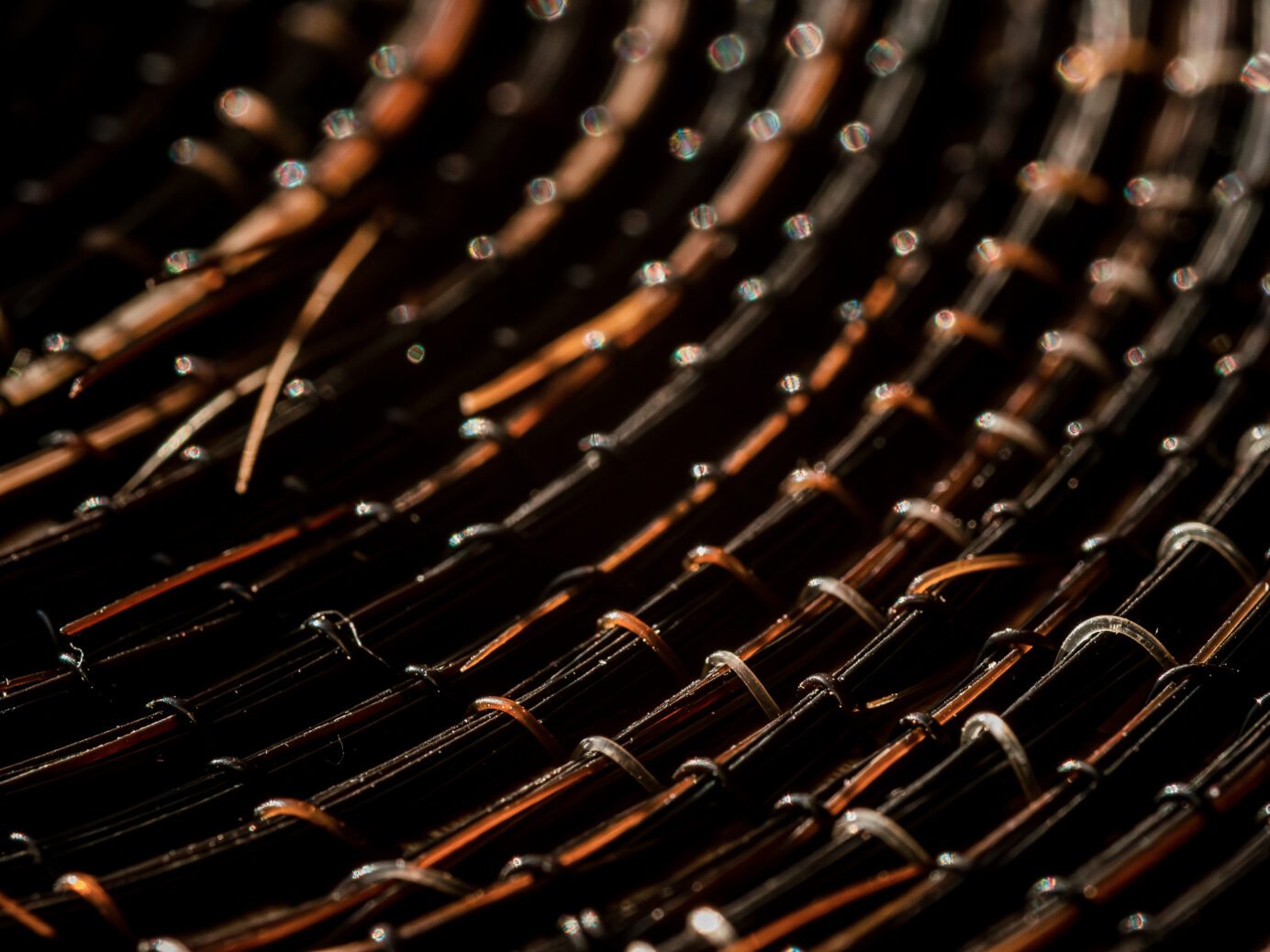
Replicating the Kirtomy Bronze Age Horsehair Hat
Re-creating a 3,000-year-old hat found in Sutherland
Funding from the Society of Antiquaries of Scotland supported professional historical costumier, Lilja Husmo, in the reconstruction of a unique 3,000-year-old hat to understand and demonstrate the technique of its manufacture.
Introduction
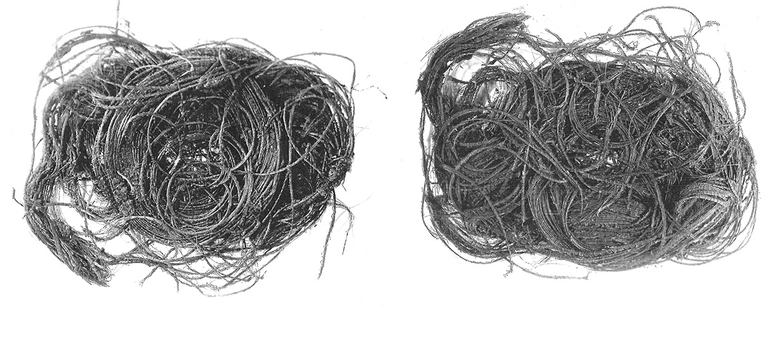
Photos from the 1960s taken just after the arrival of the find at National Museum of Antiquities of Scotland (NMAS). The left shows a a view from the top, and the right shows a view from the bottom. © NMS
The Kirtomy hat was found in the 1960s in a peat field by a crofter, Donald John Mackay, and his daughter Babette. The hat was originally researched by Audrey Henshall of the National Museum of Scotland, but for some reason was laid aside in favour of other projects. The hat was tangled in a heap of hair when it arrived at NMS. Henshall untangled, documented and measured the hat, writing notes on construction theories. The hat was ‘re-discovered’ in the early modern section of the NMS store in 2014 during a move of the collection. Dr Alison Sheridan FSAScot took particular interest in the hat. She arranged for carbon-dating and further research on the hat, discovering that it was much older than originally thought – 3,000 years old in fact. Further research on the hat was undertaken by fibre and textiles expert Dr Susanna Harris FSAScot (Univeristy of Glasgow).
Since the hat is quite fragile, and hard to recognise as a hat for the public, I came aboard the project to make a re-creation showing what the hat could have originally looked like.
Replicating the hat – technique and process
I started by analysing Henshall’s original notes on the hat that were written in the 1960’s. I then travelled to the NMS collections to observe the hat in person and take proper measurements. Using the visual evidence, Henshall’s notes, and Dr Harris’ expert observations, I started developing a theory to how the hat could have been made. The theory was that it was made of overlapping pieces of straw, then woven with a basket-twining technique using a warp (straw), weft (bunch of horsehair), and a running weft (single, or double, horsehair).
Straw was chosen as it was the most likely material, straw would have disintegrated in the conditions that kept the horsehair. It is easy to work with and was available 3000 years ago. It is also available to purchase ready sorted and dried. The re-creation was therefore made of horsehair and straw as Henshall indicated. Straw was purchased form a supplier of millinery straw. The horsehair was gifted, a small bunch from “Miri” in exchange for a carrot, a tail from “Casper” who passed away, and a large bunch of hair from Gail Brownrigg’s New Forest Ponies.
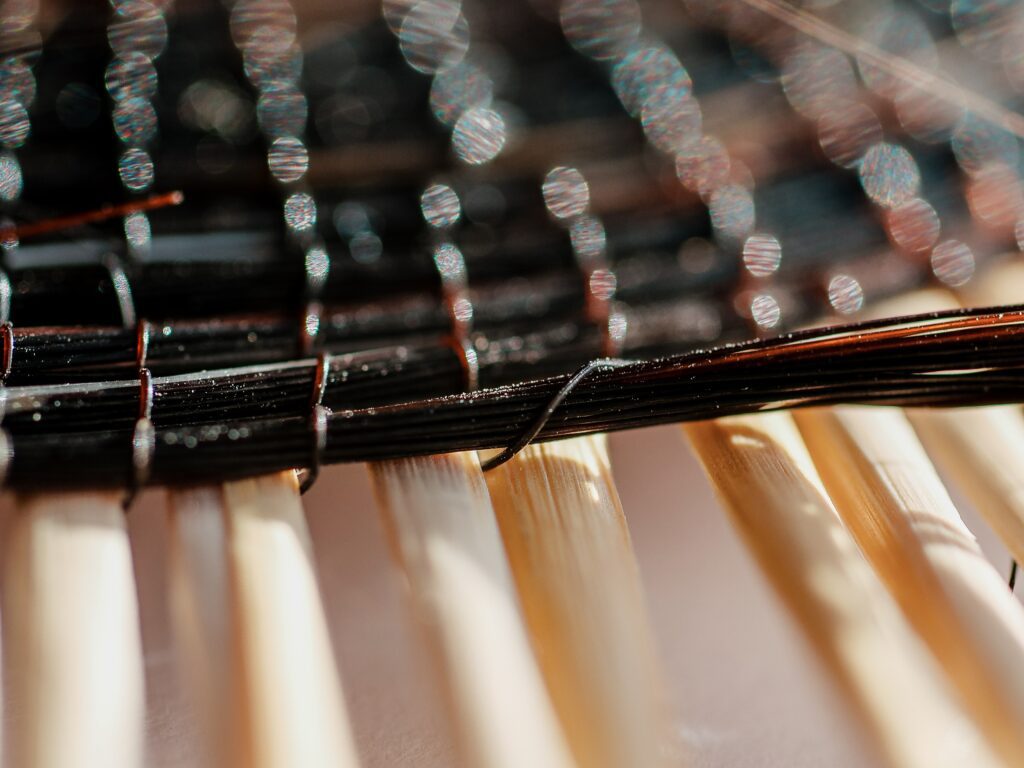
Detail of the cording on the replica hat © Lilja Husmo
Straw was trimmed, soaked in hot water for 90 minutes, then split into 1.5-2mm splints using a pin. The splints were rolled to crush the pith, then sorted and checked for flaws. Eight splints were placed in a “spider”, overlapping each other to form the centre of the crown.
The horsehair was sorted into bunches of 9-13 hairs per bunch and knotted at one end, which was anchored underneath the straw. A hair strand was then selected from the bunch and used as a running weft wrapping around the rest of the bunch (weft), then a splint of straw (warp), then the bunch (weft), and so on. When the end of each bunch was approaching, a new bunch would be slotted under the straw, then fed into the previous bunch.
As each row was added, straw splints would be placed wherever there was naturally a space for it between the others, then the running warp would be wrapped around it creating an even spacing between the running weft hair. When more straw needed to be added, a splint would be tucked underneath the straw, then the running warp would be wrapped around both the original splint and the new splint. Once the top of the crown was finished. The hat was re-soaked in hot water to make the straws malleable. The straws were then gently pressed in at an angle to create the crown sides. The hat was then set to cool and dry. The shape was carefully maintained while continuing weaving the crown sides in the same manner as the crown top. The width was reduced by skipping a splint every 10-20 splints.
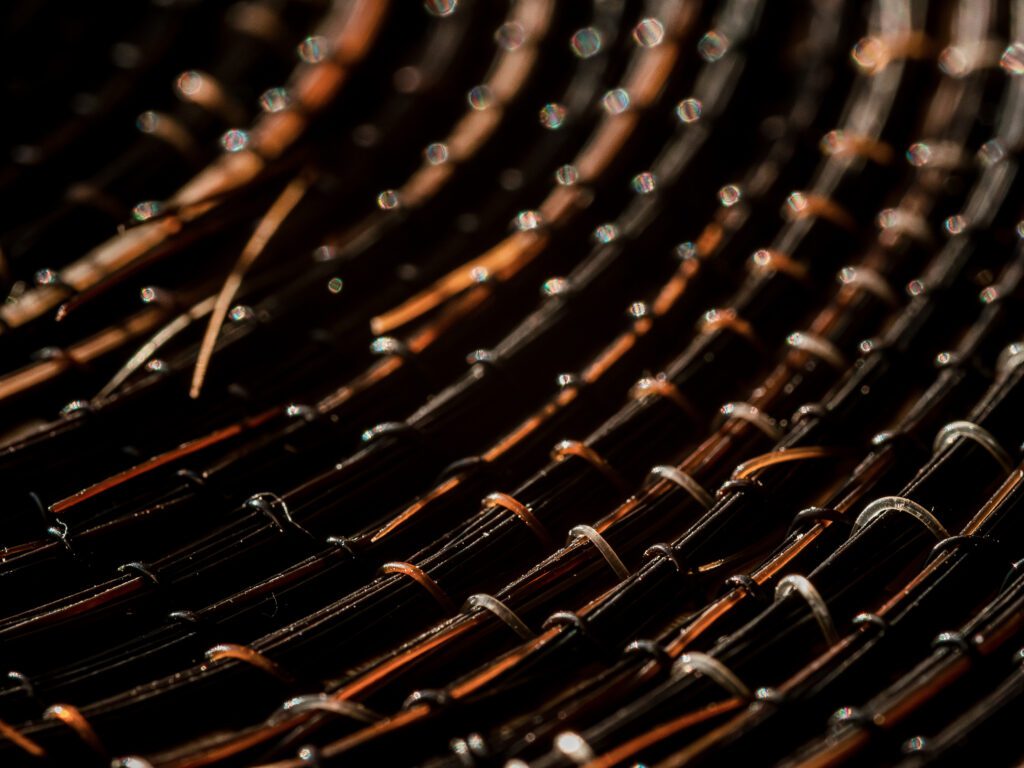
Closeup detail of the replica hat © Lilja Husmo
Once the correct measurement was reached, the hat was again soaked in hot water and pressed outwards to create the brim. The brim was woven in the same manner. Once the edge of the brim was reached, the hat was again soaked in hot water. I decided to braid the straw to finish of the edge of the hat. Due to preservation conditions, only the horsehair of the original hat survived. There was nothing left of the base, or evidence of the horsehair being used to finish the edge. The base would need to be finished off, otherwise, the horsehair would slip and undo itself over time. Tucking and braiding the edge seemed the best option, as it is a simple technique used in basketry.
There was no evidence the facing and the brim were connected via horsehair, so I decided to weave the facing separately and attach it afterwards. A fabric circle the size of the crown was cut out, and straw splints were temporarily attached to it while the first three rows of horsehair was woven. The supporting circle was then removed. The facing was then woven in the same manner as the rest and finished off with the same braid as the brim. The two pieces were then attached by the braids on the outer brim by weaving/sewing a linen thread between the braids.
The work all in all took around 250-300 hours of labour, including the samples. Towards the brim of the hat, a single woven round could take up to an hour of weaving.
The re-created hat has been photographed in detail. I have also brought it with me to conferences, as well as bringing it to class (Archaeology class at Glasgow University). I have created a sample piece for people to touch and look at the construction in detail without damaging the hat. It is hoped that the hat will be displayed in a museum.
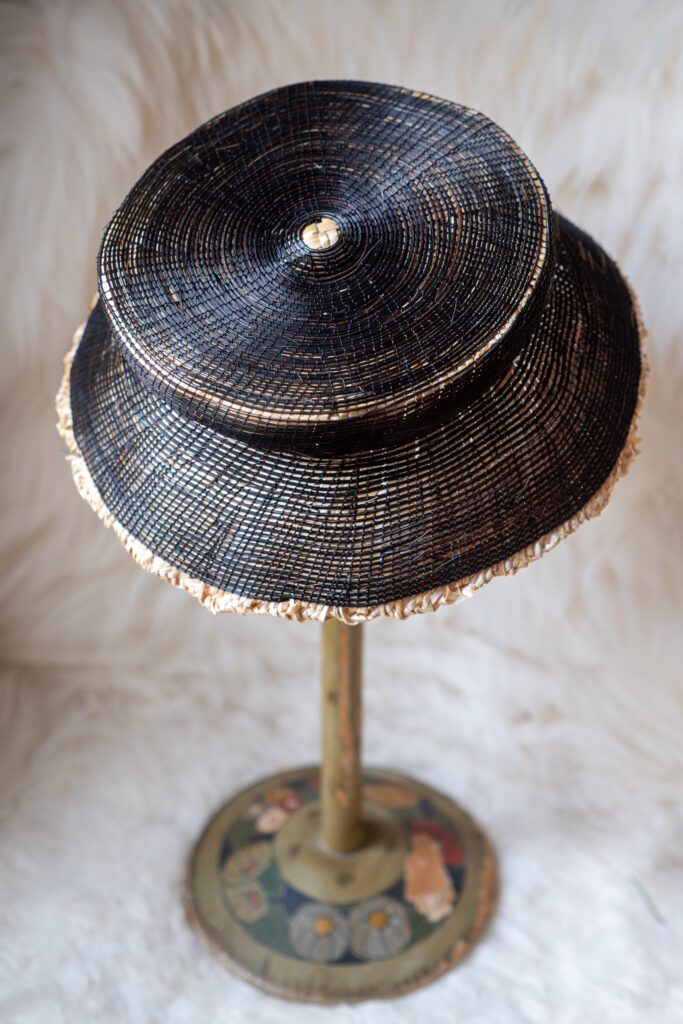
Finished replica of the Kirtomy hat © Lilja Husmo
Raising public awareness
The hat has been featured in several social media posts, including posts from National Museum of Scotland as well as The Scotsman newspaper. The hat was presented at the ARP (Archaeological Research in Progress) conference, the Highland Archaeology Festival, and at the Bronze Age Forum in 2025. The re-creation process was also presented at the Historical Clothing and Textiles in Europe Conference in February 2026.
Dr Sheridan, and Dr Harris’ research findings on the original hat, along with my own research, was published in 2025 in ‘Common ground in Scottish Archaeology – Contributions in honour of Anna Ritchie’. The re-creation was also filmed and will be edited to use on social media, and it is hoped that in the future the footage will be used to create a mini-documentary on the story of the hat.
The process of the re-creation gave new insights into how the hat was constructed. Using the theorised method of Wrapped Twining with a straw base, produced a hat that looked very much like the original, only in a 3D- shape. The project also shed light on some new questions that might not have been thought of otherwise: ‘How was the brim and the brim-facing attached originally?’, ‘How much time goes into the prep-work like soaking and splitting straw and sorting horsehairs?’, ‘Which tools were used to create the hat?’.