


News | Posted March 25, 2026
Society Funds Experimental Archaeology Connected to the Book of Kells and More with Latest Grants
The results of the new research project may help establish that a medieval manuscript once dubbed ‘the most precious object of the western world’ could have been created in Easter Ross.
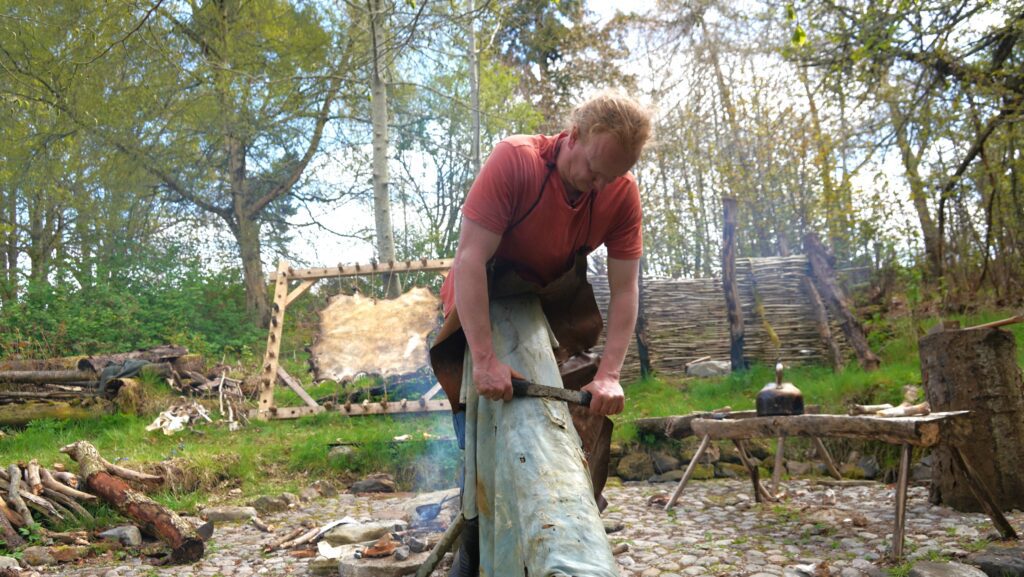
Master Craftsman, Thomas Keyes, has been awarded funding from the Society to conduct an experimental archaeology project which could reveal whether the Book of Kells has Scottish origins (© Norman Strachan)
Announced today, the £2,779 grant from the Society will enable Master Craftsman Thomas Keyes to conduct an experimental archaeology project later this year. Keyes hopes to gain a better understanding of the vellum workshop which was excavated at the monastic site of Portmahomack in the late 1990s and early 2000s.
It remains the only example of an early-medieval vellum-working site in Northern Europe and is considered to be a possible production site for the Book of Kells, which has been held at Trinity College Dublin since the 17th century.
The Book of Kells
The Book of Kells is an illuminated account of the four Gospels of Matthew, Mark, Luke and John. According to tradition, monks created the book at St Columba’s monastery on Iona, an island off the west coast of Scotland, before it was moved to the abbey of Kells in Ireland. However, the location and exact period of production, as well as the identity of its original creators, remain the subject of debate.
Unlike evidence for production on Iona, which is largely documentary, Portmahomack has physical evidence that demonstrates that this monastic site could produce an early medieval manuscript as complex as the Book of Kells; the only site with this type of compelling evidence currently known in Scotland.
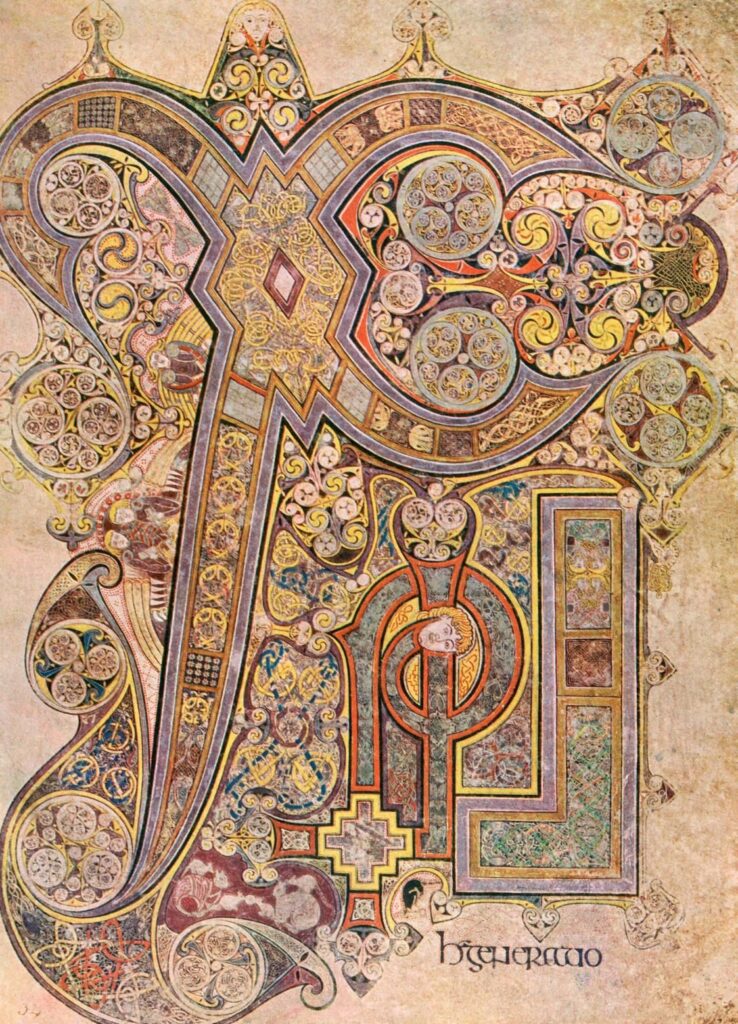
Folio 34r of the Book of Kells, the Chi Rho page, expanding the first two letters of the word Christ (Public Domain, https://commons.wikimedia.org/w/index.php?curid=44550)
The Excavations
During the 8th century AD, a thriving monastery existed at Portmahomack in Easter Ross.
Between 1994 and 2007, archaeologists led by Professor Martin Carver FSAScot and Cecily Shakespeare FSAScot excavated an area around the church of St Colman at the site, the results of which were published by the Society in 2016 and are free to read in our open access e-book.
The excavations revealed a workshop for the production of vellum, fine parchment made from the skin of a calf which was the writing surface favoured by monks when it came to the production of illuminated manuscripts. The dig also uncovered bone pegs used for stretching the vellum as it dries and tools such as knives and pumice stones for scraping and smoothing animal hides. In addition, they discovered fireplaces containing evidence of the burning of toothed wrack seaweed which was used to form soda ash, an alkaline substance that could have been mixed with water and used to dehair the hides in the 1,500-litre stone-lined tank found nearby.
Dr Helen Spencer FSAScot, Head of Research at the Society of Antiquaries of Scotland, said:
‘The excavations at Portmahomack revealed lots of physical evidence for mass production of early medieval manuscripts. The footprints of craftworking buildings were found along with evidence for different stages of production, including the creation of vellum, pigments for the pages and glass stud mounts for the cover and bindings. Incredible gospels books were definitely produced at Portmahomack and Thomas Keyes’s experiment could bring us closer to knowing whether the Book of Kells was one of them.
As a charity, we are especially grateful to our thousands of Fellows across the globe, whose subscription fees enable us to distribute grants like this each year. If you would also like to support our work, please consider becoming a Fellow to help cover the cost of high-quality research into Scotland’s past.’
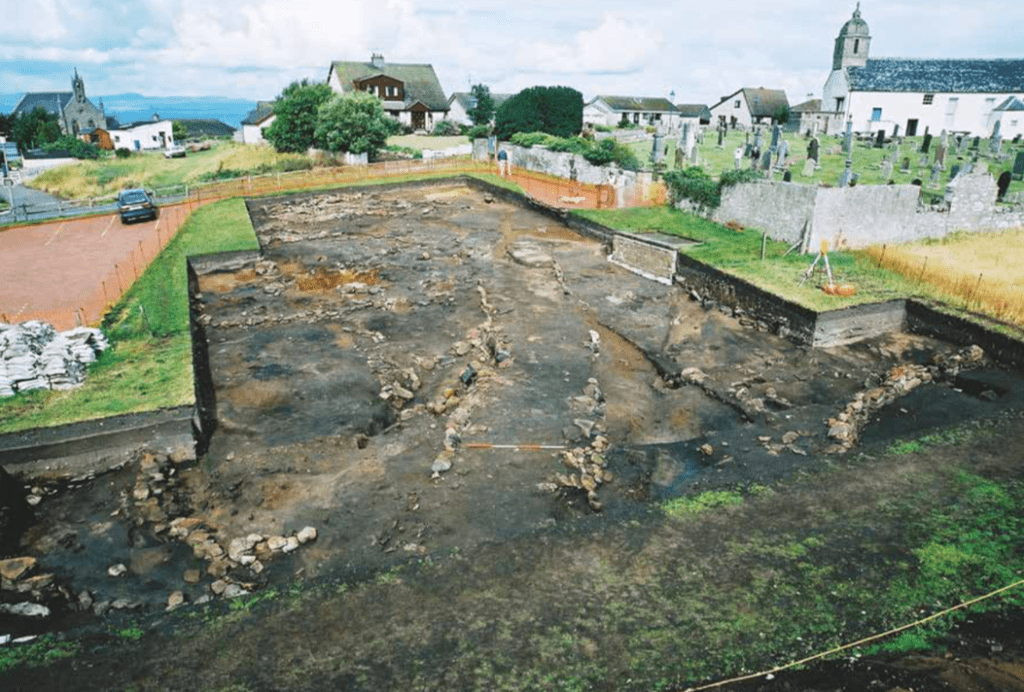
The northern early medieval workshops at the Portmahomack monastery site, looking north towards the Dornoch Firth (© FAS Heritage)
Experimental Archaeology
Master Craftsman Thomas Keyes has already created four reimagined pages of the Book of Kells from scratch using techniques and replicas of tools discovered at Portmahomack. However, a key step was missing in the process.
Thanks to funding from the Society, Keyes will now be able to construct a replica of the washing tank found on site which was used to prepare the animal hides for the production of vellum using seaweed lye, traces of which were found in hearths near the original tank.
This method of experimental archaeology will create vellum samples which will then be compared with surviving manuscripts of the period, including the Book of Kells, allowing certain production techniques to be attributed to specific manuscripts which could help determine their provenance.
Keyes said:
“The parchmenarie (vellum workshop) at Portmahomack is both unique and unusual. Usually, lime is used in the production of vellum parchment, but this is not found locally. Seaweed lye may have been used instead which is a less caustic process with bacteria growing in the solution to process hides. Pages from some manuscripts from the period, including the Book of Kells, have numerous pock mark holes which could be evidence of bacteria eating through the hides as they were being processed. Reconstructing the hide soaking tank will shed light on the finer details of this process and the parchment samples produced can be compared directly with original manuscripts.”
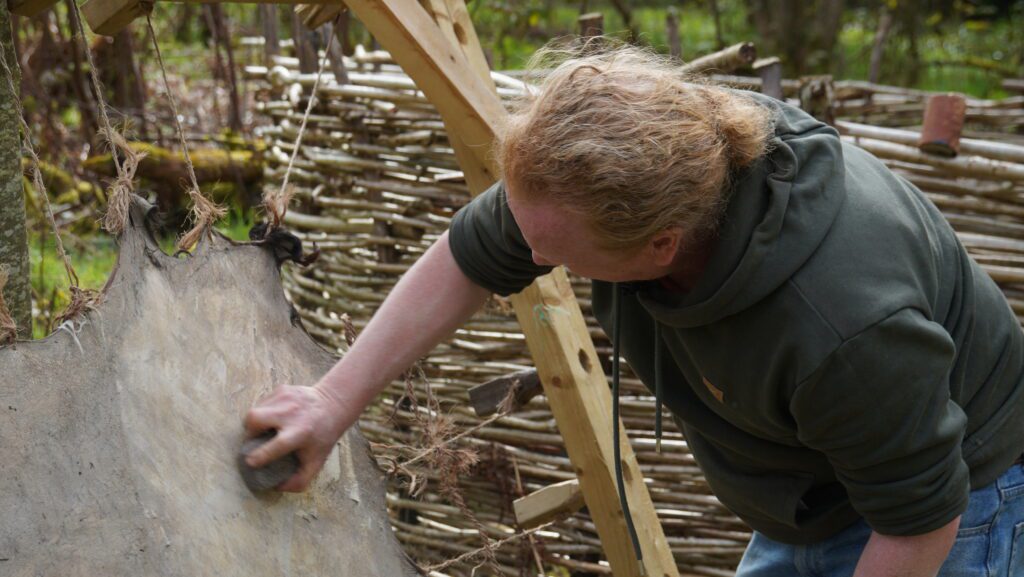
Master Craftsman Thomas Keyes pumicing the flesh side of a calf skin (© Norman Strachan)
The results will be published online by Tarbat Discovery Centre and shared in a public lecture in late 2026. The new vellum will be used in other projects to create more examples of the type of manuscripts produced at Portmahomack 1,200 years ago.
Calum Thomson, Chair of Tarbat Historic Trust, said:
“The Tarbat Discovery Centre has been delighted to work with Thomas over the past few years on the Stories on Skins project. The possibility that Portmahomack was where the Book of Kells was first produced is incredibly exciting for the region and this new research could provide more evidence for this. We look forward to welcoming visitors to our museum to learn more the early Pictish monastic site and see the four amazing manuscript pages already created by Thomas.”
The Society of Antiquaries of Scotland supports high-quality research and publication relating to Scotland’s past. This round awarded £20,769 to nine projects researching aspects Scottish history and archaeology:
- Tarbat Vellum Tank Experiment – funding the recreation of an early medieval washing tank discovered at the site of Portmahomack monastery in the Highlands, to aid in the investigation into the provenance of surviving manuscripts of the period, including the Book of Kells
- Out of the Salt Pan, Into the Firth – fieldwork excavation and survey at St Monans saltworks complex in Fife while engaging both youth groups and military veterans in archaeology to develop skills, combat isolation and build up confidence
- Dating Human Remains from Nave Island – radiocarbon dating of human skeletal material from a possible Viking structure on Nave Island in the Inner Hebrides
- Hinge-Mounding Archaeology – a community walkover survey in a forested area in Crieff, Perth & Kinross, following the discovery of a prehistoric flint flake in late 2025
- Mesolithic Tarradale Post-Excavation Analysis – analysing finds from an ancient shell midden created over 5,500 years ago at Tarradale in the Highlands
- Northeast Dendro Framework Project: Burghead – dendrochronological (tree ring dating) analysis of three timbers identified during excavations at Burghead fort in Moray in 2025 in order to build an early medieval dendrochronology for Northeast Scotland for the first time
- Lismore: Illustration of Finds – illustration of the internationally important assemblage of finds uncovered during community excavations at the early medieval monastery site of St Moluag in the Inner Hebrides
- The Cairns Excavation Project – continuing excavation work at the site of a large Iron Age broch and structures dating from the Iron Age through to the Norse period in South Ronaldsay, Orkney
- Community Excavations at Achtercairn Gairloch – complete post-excavation analysis for the community excavations of the Iron Age roundhouses at Gairloch in the Highlands
You can read about many of our past Society funded research projects here.
Anyone who is interested in Scotland’s history and archaeology is welcome to apply for Fellowship of the Society of Antiquaries of Scotland to help support our work and enjoy a range of benefits. The next deadline for Fellowship applications is 30 September 2026. Our grants are also open to everyone, and the next deadline is 30 April 2026.