


“Standing on the Edge of Being: Scotland 1850 to Cop 26, an Environmental History of Scotland” by Richard D Oram
Reviewed by Dr Edward Stewart FSAScot
Standing on the Edge of Being: Scotland 1850 to Cop 26, an Environmental History of Scotland by Richard D Oram, Birlinn Ltd: Edinburgh, 2024, hardback, illustrated, 432 pages. ISBN: 9780859767187, RRP £75.00. Reviewed by Dr Edward Stewart FSAScot, November 2025
This volume, the final in Professor Richard Oram’s FSAScot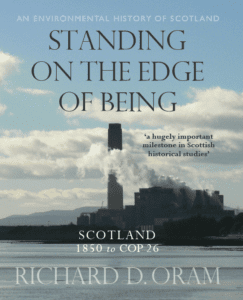 An Environmental History of Scotland series, carries us forward to the contemporary at pace, at each turn provocatively reflecting on our energy age. This builds on Richard Oram’s previous volumes in this series, A Land Won from Waste which carries us from the Iron Age to medieval, and Where Men No More May Reap or Sow which charges from the medieval, through the
turmoil of the Little Ice Age to the Lowland and Highland Clearances. Standing on the Edge of Being brings the reader from the 1850s to the very recent past arguing, with flair and passion, the need for broader public engagement to shape a just transition to carbon neutrality for Scotland.
The first two chapters explore the energy politics of modern Scotland, from the decline of peat and the age of coal, shale oil and gas, to the development of hydro-electric power and the proliferation of energy infrastructure and industrial centres into rural and Highland Scotland. Through these chapters Oram reflects on some of the foundational inequalities of modern Scotland including unequal access to energy in rural and urban areas, the disproportionate impacts of the ‘clean energy’ revolution on rural communities, and the slow development of public health legislation in response to industrial pollution of our air and water. Through the campaigns against hydro-developments in the 1950s and 60s, Chapter two powerfully reflects on the roots of contemporary divisions in environmental politics between urban and rural Scotland at their most heated within the Highlands.
In Chapter three the sanitisation of Scotland’s cities through waste-water treatment and the development of clean water supplies is explored, delving into how not only human but non-human communities from shellfish to salmon were impacted by the growth of urban communities and expansion of their industries. Chapter four returns to rural Scotland and considers the expansion of industry into the rural landscape in the 19th and 20th centuries. This chapter powerfully begins with a reflection of the role of popular perception in the environmental consciousness and politics of Scotland and the role of the perceived ‘pristine wildness’ of many rural landscapes in policy-making, planning and land management. Oram effectively argues here for the need for public engagement around land-use histories and the industrial as well as agricultural legacies which continue to shape the ecologies and aesthetics of rural Scotland, to de–polarise debates around the future of our land and water. Chapter seven brings us to the development of mass tourism, conservation ethics and new forms of land management in rural Scotland. The right to access land, so critical within a country with such centralised landownership as Scotland, is explored with reflection on the hard-fought process of achieving our current ‘right to roam’ and the impact this has on particularly fragile upland environments. In this chapter the development of organisations such as the Scottish Youth Hostel Association, the National Trust for Scotland and Nature Scotland, and the eventual development of Scotland’s National Parks and National Nature Reserves, are put into their context both nationally and internationally.
Chapter eight considers the changing nature of agriculture in an industrialised Scotland, Chapter nine reflects on the past and present tension between development and conservation in rural Scotland, while Chapter ten, titled ‘Environment or Jobs?’, cuts to the core of these issues. Chapter eleven focuses on the drive for cheap and clean energy in the late 20th and 21st centuries, while Chapter twelve explores the arguments for and against reintroduction, reafforestation and rewilding, charting the development of these concepts, their place in policy, planning and landscape perception, and how they have come to dominate debates around the future of rural Scotland. Through these chapters Oram reflects critically on the tension which exists between the needs of the communities of modern Scotland; homes, heat, employment and more, the impacts these have on our environment, and the conflicts this creates within the environmental politics of the nation. Chapter thirteen considers the pertinent issues of water quality to both our environment, ecology and human communities in the recent past and present, this topic, rarely far from headlines at present, is hugely important in shaping our relationships with water in an age where communities increasingly seek to reconnect with our rivers, lochs and seas for wellbeing. Chapter fourteen brings us to the thread which connects these chapters, the climate crisis as it increasingly impacts us today both locally and globally, and the changing attitudes to the climate crisis that have developed over the 20th and 21st centuries from. Oram places the debates explored across this volume in their global perspective here making relevant Scotland’s environmental history to debates which will shape the habitability of our planet.
This volume concludes with a reflection on where we are today, from the rise and mainstreaming of an anti-climate change right wing in both the UK and America, to the failure of both local governments and the global community to meet targets to mitigate climate change, the hypocrisies of COP-26 and the apparent abandonment of the ‘Glasgow Pact’ by the world’s leading industrial nations, and a polarisation of debates around landscapes futures. As the conclusion is titled: ‘Where do we go from here?’ Oram calls for outrage – metered with self-reflection – we should both be aware of our own contributions to this crisis and angry about the failure of our national institutions to hold the worst offenders to account, and we should use these feelings. Action is needed now, by us the Scottish public, to hold ourselves, our governments, corporations and institutions to account, this volume ends:
“What direction is taken in respect to the environment can and should be ours to choose, but each and every one of us needs to be active in our choosing and alive to the consequences of our choices, for what we do next will shape the future for generations to come.”
Edward Stewart FSAScot
