Re-evaluating Orkney’s runic inscriptions
Field Runologists’ gathering in Kirkwall, Orkney
A grant from the Society of Antiquaries of Scotland supported Professor Judith Jesch FSA Scot (UHI) and Dr Jasmin Higgs (University of Nottingham) in sharing their research and experience with the Field Runologists’ group in Orkney.
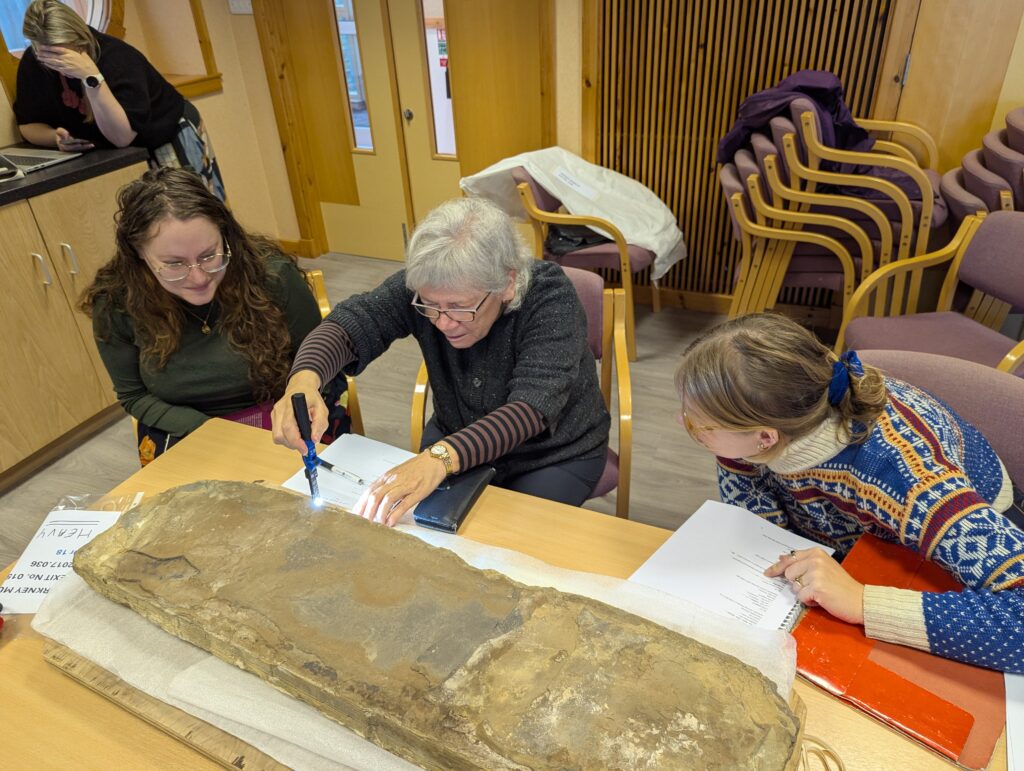
Judith Jesch and Jasmin Higgs examine Or 18 with a Danish runologist © Loraine Jensen
Introduction
A corpus of around fifty runic inscriptions in Orkney from the Viking Age and medieval period may seem relatively small compared to the total of around 7,000 inscriptions in Scandinavian runes. However, it is the largest sub-corpus in Britain and Ireland and new finds continue to be made. Orkney is also of interest for some modern, ‘fake’, or imitation inscriptions found or produced there. Most of this corpus has been published by Barnes (1994) and Barnes and Page (2006), but there are several new finds since these publications and some previous interpretations need revision. The inscriptions are identified using a geographical abbreviation and numbering system, with ‘Or’ representing runes found in Orkney (eg ‘Or 20’ represents the rune found at Breckness).
In 2025, Professor Judith Jesch invited the Field Runologists’ group to Orkney for their annual meeting in order to study the inscriptions in situ in the company of experienced field runologists who could help make connections with inscriptions from other areas. The planned activities were in preparation for an article re-evaluating this corpus.
The 36th Field Runologists Workshop
Twenty field runologists from Scandinavia, Germany, the UK and North America gathered in Kirkwall. The morning of 20 October was spent at UHI Orkney, which provided a suitable study room and microscopes so we could work on inscriptions brought there from Orkney Museum, Skaill House Museum and Sanday Heritage Centre. In the afternoon, we made a short excursion to locations where runic inscriptions had been found, Breckness (Or 20) and Bay of Skaill (Or 18 Skaill Home Farm and Or 13 Skara Brae), to experience and discuss the archaeological and other possible contexts of runic writing in Orkney. At these sites, we discussed whether the sites at which inscriptions have been found can be correlated with sites mentioned in Orkneyinga saga. Breckness may be tangentially mentioned in the saga, but the Bay of Skaill area is notably absent.
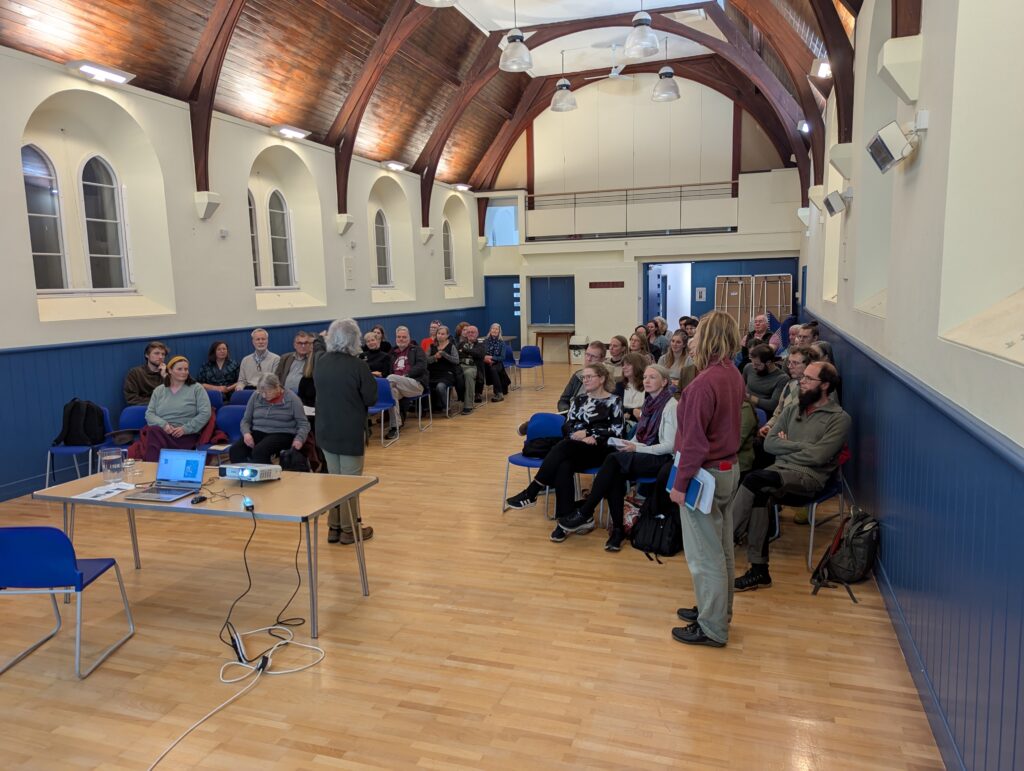
Public engagement event in Kirkwall © Loraine Jensen
On the evening of 20 October, in a public event at the St Magnus Centre in Kirkwall, twelve of the participants gave short, five-minute talks, each about one interesting inscription, to an audience of 50. The talks covered five inscriptions from Maeshowe, four from elsewhere in Orkney and three from Shetland, Sweden and Canada. Several of the speakers proposed new readings or interpretations of their chosen inscription.
21 October was an all-day excursion to runic sites. The first stop was the Bu of Orphir, a site mentioned in the saga, where several inscriptions have been found on stone and animal bone in the church ruin and Viking Age horizontal mill. One of the inscriptions (Or 19) has been given a new reading in Colleen Batey’s new monograph on the site, after recognising that some of what were previously thought to be separate bone fragments can be joined up and more runes identified as a result. After studying the bone fragments at the college the previous day, the runologists in general approved the new reading.
At Maeshowe, where 33 examples of mid-12th century Norse runic graffiti have been found, we were given private research access by HES. This enabled everyone to examine every inscription and discuss them with colleagues. There was some discussion about which of the inscriptions could have been carved by the same person, and some small adjustments to previous readings were suggested.
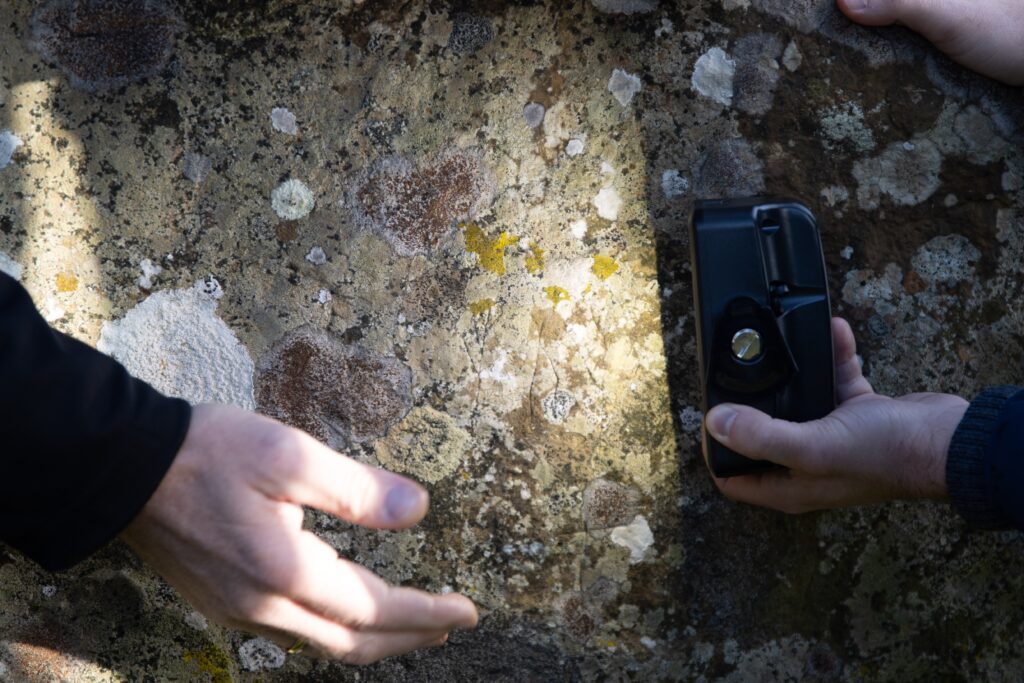
Studying runes at the Ring of Brodgar © Karen Langsholt Holmqvist
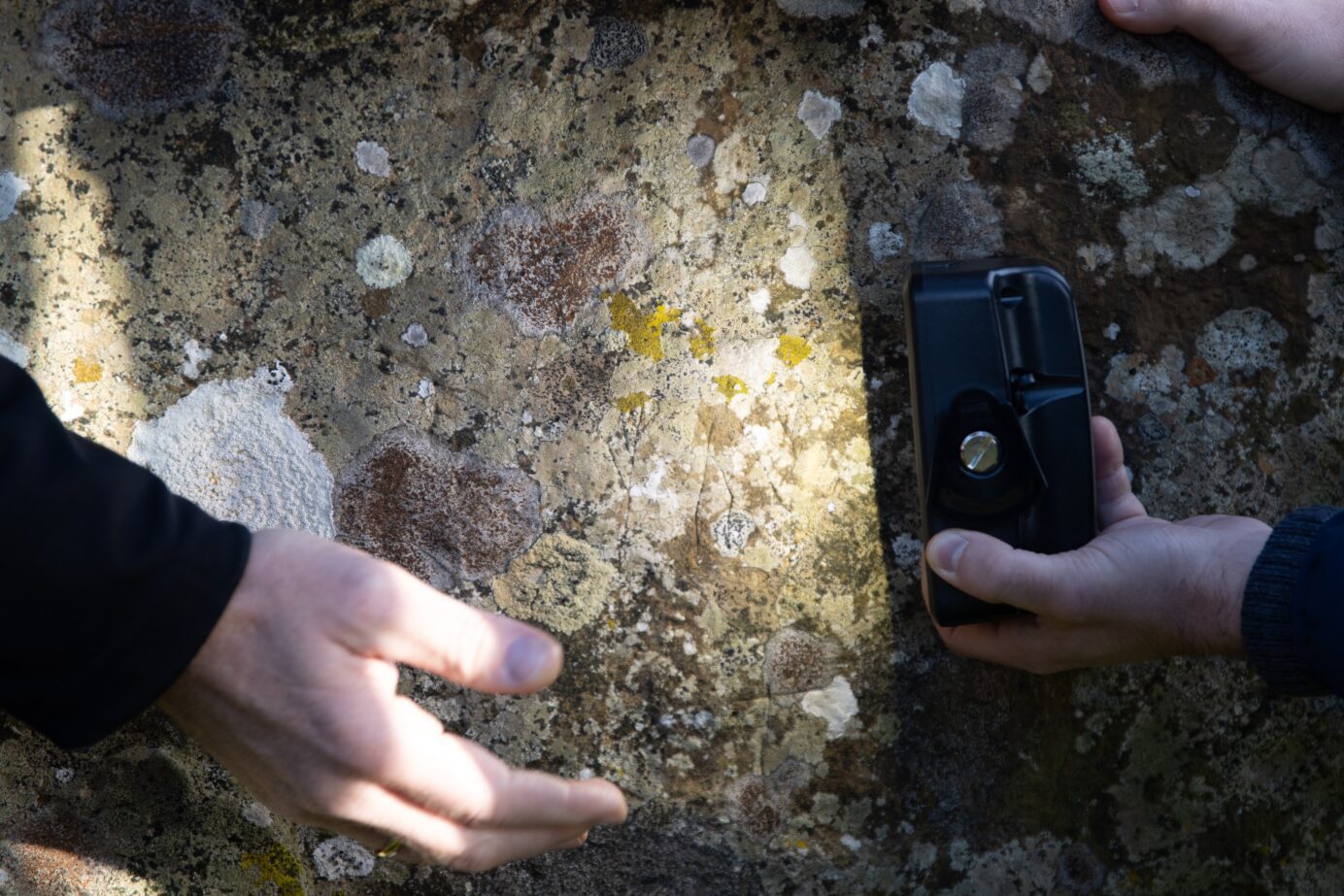
The excursion passed through runic find locations at Naversdale (Or 23) and Stackrue Broch (Or 1), once again to discuss the significance of find spots and their relationship with postulated original locations. We also visited the runic graffito at the Ring of Brodgar. The final stop was the Brough of Birsay where one rune-stone (Or 16) is still in situ in the church ruin and two (Or 8 and Or 9) are in the custodian’s hut, to which we were again given access by HES. All three of these stones are affected by lamination, but we could confirm that there had once been runes on them and potentially identify the number of runes and in some cases the likely runes. On the whole, the group was sceptical towards the suggestion that Or 8 and Or 9 were once part of the same rune-stone. This means that there is a greater number of individual runic inscriptions than previously thought from the Brough (along with Or 6 in Edinburgh). Once again, it was important to consider the archaeological and historical context of these finds. In the saga, Birsay is associated with Earl Þorfinnr the Mighty, but the runic inscriptions more likely belong to the later important medieval ecclesiastical site on the Brough.
At the group’s business meeting on 22 October, we discussed some details of the readings of the inscriptions and suggested adjustments, both to the readings of individual runes and to the interpretation of the inscriptions, including what the fragmentary ones might have said. These discussions will feed into subsequent publications by the participants. Finally, at the Orkney Museum store we examined the modern inscription Or 13 Skara Brae (originally published as a medieval inscription) – we confirmed that the inscription is indeed modern. Experience of modern inscriptions is vital to the field runologist, to understand how they differ from Viking Age and medieval inscriptions, and to enable them thus to distinguish old and modern inscriptions when new ones are found.
Acknowledgements
Judith Jesch and Jasmin Higgs are grateful to the Society of Antiquaries of Scotland for funding our expenses. Judith and Jasmin are now working on an article which will explore the links between archaeological sites and runic literacy, apply Jasmin’s pragmaphilological approach to the inscriptions and test the suggested new readings and interpretations.
Funding from the Orkney Archaeological Society contributed to the costs of the excursions and the public event. Additional funding for the meeting was received from The Viking Society for Northern Research and Kungl. Gustav Adolfs Akademi in Uppsala, Sweden. We are grateful to all of these bodies and especially to everyone in Orkney who made the fieldwork and the discussions possible.
References
Barnes, M. P. 1994. The Runic Inscriptions of Maeshowe, Orkney. Uppsala.
Barnes, M. P. and Page, R. I. 2006. The Scandinavian Runic Inscriptions of Britain. Uppsala.
Batey, C. E. with Rachel Barrowman and Ingrid Mainland 2025. The Earl’s Bu, Orphir: Feasting, Farming and Commerce at the Heart of the Norse Earldom of Orkney. Kirkwall.