


News | Posted December 11, 2025
Society of Antiquaries of Scotland 2025 Award Winners
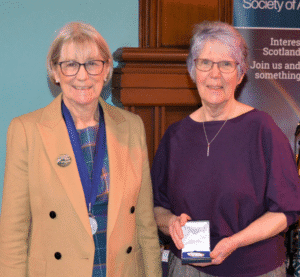
Diana Murray FSAScot, President of the Society of Antiquaries of Scotland, and Christine Yuill FSAScot, recipient of the Dorothy Marshall Medal
The Society supports high-quality research and publication relating to Scotland’s past by making several awards at our Annual General Meeting (AGM) each November. At the 2025 AGM, the President announced the winners of the R B K Stevenson Award, the Murray Prize for History and the Dorothy Marshall Medal.
R B K Stevenson Award
Formerly a Keeper of the National Museum of Antiquities of Scotland, and President of the Society between 1975 and 1978, Stevenson’s writing frequently appeared in the Proceedings of the Society of Antiquaries of Scotland (PSAS). He was an honoured member and a friend of the Society throughout his life. The annual award was established following Stevenson’s bequest in 1992.
The RBK Stevenson Award is offered annually in recognition of a paper published in the Proceedings that best reflects the high standards in scholarship of R B K Stevenson CBE FSAScot.
The prize this year was awarded to ‘Revisiting Knap of Howar, Papa Westray, Orkney’ by Hazel Moore FSAScot and Graeme Wilson FSAScot, with contributions from Seren Griffiths.
Murray Prize for History
This award was funded through a generous donation from Dr Peter Murray FSAScot.
This award is given in recognition of original research published by the Society on the history of Scotland from the medieval to Early Modern periods (c AD 500 to AD 1700) and set within a British and/or European context. For the purposes of this award, history is defined as encompassing all fields of study except archaeology. All papers submitted for publication in the Proceedings of the Society of Antiquaries of Scotland (PSAS) which meet the criteria are considered for the award.
The prize this year was awarded to ‘Watching the waters: sentinel sites in the Inner Hebrides and western seaboard of Scotland’ by Shane McLeod FSAScot.
Dorothy Marshall Medal
This prestigious silver medal commemorates Miss Dorothy Marshall HonFSAScot who in her own long lifetime contributed so much to Scottish archaeology, especially in her beloved Island of Bute. The award marks the Society’s gratitude for the bequest to the Society following her death in 1992. A prestigious silver medal is awarded every three years to an individual who, in a voluntary capacity, has made an outstanding contribution to Scottish archaeological or related work.
This year, the Society celebrated the achievements of Christine Yuill FSAScot whose long-term commitment to Scottish archaeology is seen in her sustained excavation volunteering from 2003, and her dedicated volunteer work on unglamorous back-office tasks in the archaeological collections and archives of the National Museum of Scotland (NMS), many of them stemming from the Museum’s connection with this Society.
Christine is from Ullapool and trained as a pharmacist, spending her long professional career around Inverness. Once her family had left home, she was able to develop her interest in archaeology, notably through the extra-mural course offered at Aberdeen University in the early 2000s. This led her to volunteer annually on the National Museum of Scotland excavations at Birnie and Clarkly Hill, as well as at the Ness of Brodgar. She became a Fellow of the Society in 2013. On retirement in 2010 she moved to Edinburgh and has been a weekly volunteer in the National Museums Scotland Department of Scottish History & Archaeology since then, where she has made sustained and invaluable contributions, notably in working on archives inherited from this Society to make them useful and accessible. She is their longest-serving volunteer.
Christine has undertaken post-excavation work for Birnie, Clarkly Hill and High Pasture Cave, from sorting and cataloguing photos to preparing lists from the field records. She soon moved to a wide range of digitisation tasks, making historic images and Society of Antiquaries of Scotland archives available to researchers. She has digitised and catalogued thousands of historic photographs from the collections (soon to be uploaded to the National Museums Scotland database); carried out detailed registration of collections that arrived in the museum with very little associated archive, making them publicly accessible through the NMS online catalogue as a result; transcribed the notebooks of Orcadian antiquary George Petrie – a critical but under-utilised resource in the NMS Research Library; collated historic Treasure Trove claim and non-claim cases for the first time – which has informed the recent Treasure Trove Review; and worked through multiple box files of historic Antiquaries correspondence, cataloguing it for the first time and revealing the networks of connections. Week in, week out, she has worked away at these archives, remotely over Covid and when family commitments made it hard for her to come in. She has an impressive attention to detail, unerring ability to pick up inconsistencies and errors, and a remarkable ability to read near-illegible handwriting.
Tasks like these are critical to enabling wider access to archives, notably those that relate to the shared history of the Society and the Museum. They are key to the better understanding of collections; they create the bedrock and linkages that make much other work possible. She is currently working her way through re-cataloguing many of the Antiquaries’ excavations of Roman sites in the late 19th and early 20th century, when publications focused solely on a few glamorous items and museum catalogues followed suit. Her work in this area, as with so much else of what she has done, makes material available that would otherwise languish in the archive.
Christine’s contributions have not been glamorous or high-profile, but they have made a substantial difference. For this dedication over the last fifteen years, sometimes during very challenging circumstances, to an oft-overlooked task in the service of Scottish archaeology, she is a highly appropriate recipient of the Dorothy Marshall Medal.
To find out more about our awards, please visit our Grants & Awards page.