St Moulag monastery, Isle of Lismore
Excavation and post-excavation results from a significant monastery
Grants from the Society of Antiquaries of Scotland helped to support two seasons of community excavation on the island of Lismore, organised by the Lismore Historical Society and led by Dr Clare Ellis FSAScot, Argyll Archaeology.
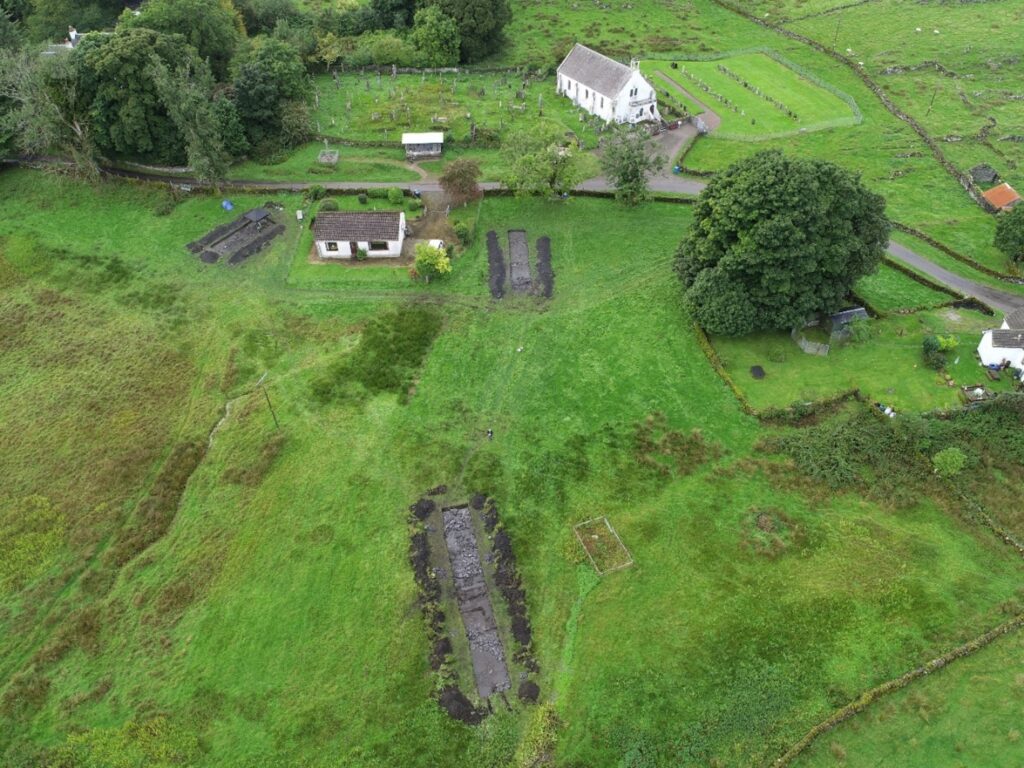
Site of the roundhouse and workshop area (lower trench), the cemetery (trenches either side of the cottage) in relation to the parish church – the former medieval cathedral © Argyll Archaeology
It has long been known from his obituary in the Irish Annals in 592, and lists of succeeding abbots, that Moluag (Mo Lugaidh) established an Early Church monastery on the island of Lismore, but there has been nothing to indicate the actual site of the monastery or what it was like. Guided by the curved boundary of the glebe surrounding the medieval cathedral of Argyll (possibly demarcating the original enclosure) and a survey carried out in 2019 by Rose Geophysics, excavation in September 2021 and May 2022 targeted the enclosed early medieval cemetery and a possible stone-built structure (MacDonald 1974, Rose 2019).
The excavations confirmed that the cemetery existed on both sides of the church house (D). The osteological assemblage comprises 16 skeletons and 1066 disarticulated fragments (Boyle 2025). There is currently no evidence that females were present. The articulated skeletons comprise newborn babies, children, and adolescent alongside adults, several of whom died in old age. Previously dated inhumations suggested that the cemetery had its inception around the 7th century, while the latest dated inhumations indicated that it continued to be used into the 13th century.
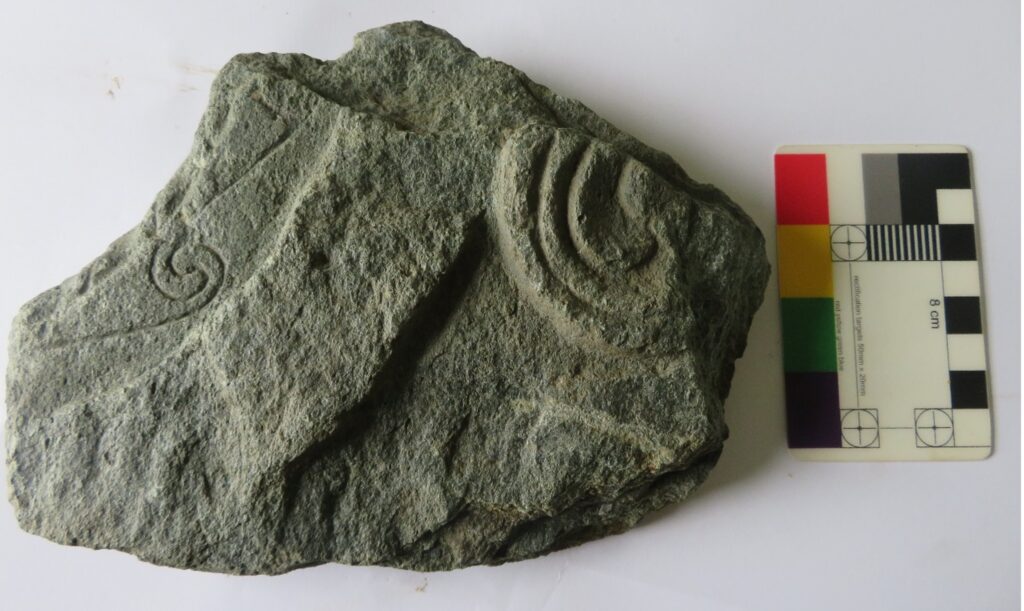
Fragment of a decorated chlorite-schist cross slab © Argyll Archaeology
As well as widespread evidence of a range of dietary deficiencies, dental abscesses, joint and spinal disease, two of the skeletons had possible peri-mortem sharp-force injuries, though it is possible that these occurred during later disturbance of the cemetery. Full interpretation of the assemblage will be completed once DNA analytical data is available. Several fragments of early medieval cross slabs were also recovered from the cemetery (Thickpenny 2023). One ringed and fully pierced cross-head fragment is of a form which appears to be unique in the corpus of early medieval carved stones in Scotland but bears comparison with the Ardagh Chalice. Another fragment with a key pattern shows remarkable parallels with cross-slabs at Applecross, Nigg and Rosemarkie.
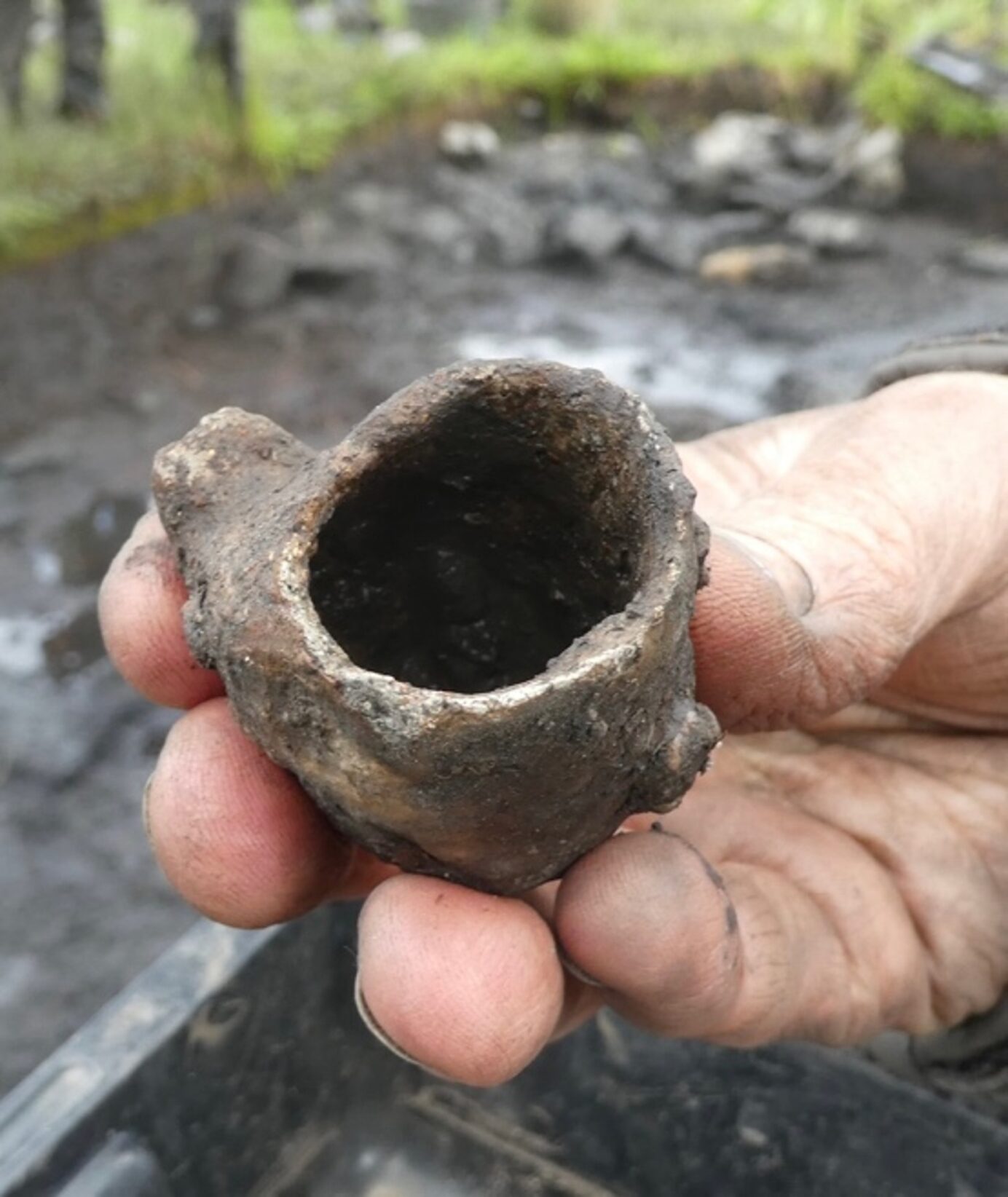
Excavation revealed the survival of a stone built, oval structure dating to 9th or 10th century. The roof of the structure had been destroyed by fire, but the building was repaired with a new flagstone floor laid in one half. The building yielded very few artefacts, but the recovery of a metal punch coupled with the fact that the building was built over peat deposits hints that its primary function was ‘industrial’ rather than domestic. However, 187 small crucibles and 742 fragments of moulds for manufacturing jewellery, including penannular brooches, were recovered from the surface of the peat outside this structure (Cruickshanks 2025a & b). X-ray fluorescence analyses of crucible surfaces revealed that they were used to melt copper, silver and gold, as found in contemporary assemblages from Dunadd, Portmahomack and the Brough of Birsay.
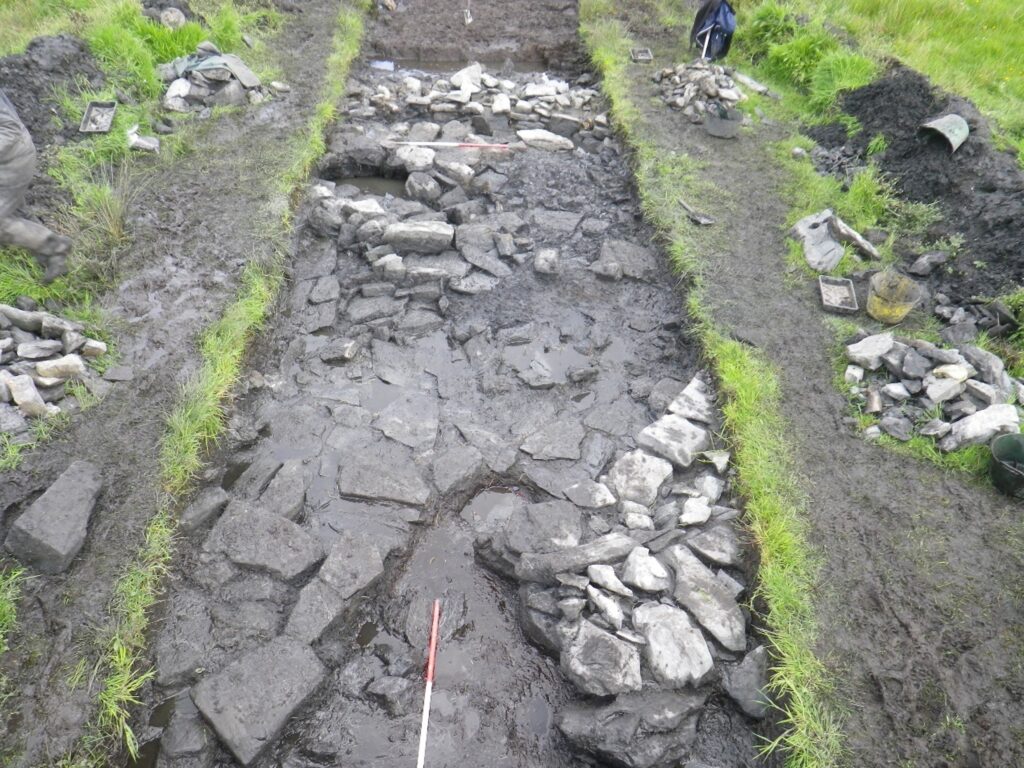
The oval stone structure and its western entrance © Argyll Archaeology
Notable finds include a fragment of a parting vessel used to separate silver and gold, and exquisitely carved bone ‘motif pieces’ which were probably used to shape gold foil for mounts (Cruickshanks 2025c). Such ‘motif pieces’ are well known in Ireland but only one other piece is known from Scotland.
Confirmation of the use of gold at the site is provided by the ‘touchstone’ for assaying gold, which was found on Lismore in the 19th century. Wooden hoops from stave vessels and fragments of a small yew box were recovered from the same area outside the stone structure, which may have been part of a house-shaped reliquary (Crone 2025). The evidence for the presence of an early medieval monastery at Clachan on Lismore is compelling (with carved stone crosses, an enclosed cemetery and skilled craft specialisation), and there is a clear connection to Ireland and northeast Scotland. The project is providing a wealth of new information to aid in the understanding of Moluag’s place in history, as well as establishing the national importance of the site.
Acknowledgements
None of this work would have been possible without the generous support of the Society of Antiquaries of Scotland; the Hunter Archaeological Trust; the MacDougall Clan Society of America; the MacDougall McCallum Foundation (USA); the Board of Comann Eachdraidh Lios Mòr, bequest Hugh MacPherson; and several private individuals via crowd funding. Thanks also goes to all the volunteer diggers who worked under often extremely wet conditions.
References
Boyle, A 2025 Osteological analysis of human remains from the glebe, Isle of Lismore, Argyll and Bute. Unpublished client report.
Crone, A 2025 Lismore parish Church: the wood assemblage. Unpublished client report.
Cruickshanks, G 2025a Metalworking crucibles from St Moluag’s, Lismore. unpublished client report.
Cruickshanks, G 2025b Metalworking moulds St Moluag’s, Lismore. unpublished client report.
Cruickshanks, G 2025c Work bone objects from St Moluag’s, Lismore. unpublished client report.
Ellis, C 2022 Data Structure Report. Excavation in the glebe lands, Isle of Lismore. Unpublished client report.
MacDonald, A D S 1974 Two major early monasteries of Scottish Dalriata: Lismore and Eigg. Scottish Archaeological Forum 4: 47-70.
Rose Geophysics 2019 Geophysical survey report, Glebe fields, Lismore. Unpublished client report.
Thickpenny, C 2023 Lismore stone fragments assessment. Unpublished client report.
You can read more about the exciting excavations at Lismore in the open access Antiquity article: A major monastic centre? Rethinking Lismore’s place in the ecclesiastical landscapes of early medieval Britain
Report prepared by Dr Clare Ellis FSAScot, Argyll Archaeology