Diversity and Scottish travel in Ottoman Greece
The case of Mary Hamilton Campbell, Lady Ruthven (1789–1885)
The Society of Antiquaries of Scotland awarded Dr Petsalis-Diomidis, University of St Andrews, to spend a week in Edinburgh carrying out the first stage of research into Lady Ruthven and meeting key stakeholders
The Project
The project aims to reassess the activity of Scottish travellers in Ottoman Greece, widening the range of people who have featured in these narratives. It does so by focusing on the hitherto marginalised artist, excavator and collector Mary Hamilton Campbell, Lady Ruthven (1789–1885). During her time in Athens (1818–1820) she initiated excavations on Cape Zoster, collected antiquities and developed her artistic practice through lessons from Giovanni Battista Lusieri, Lord Elgin’s agent.
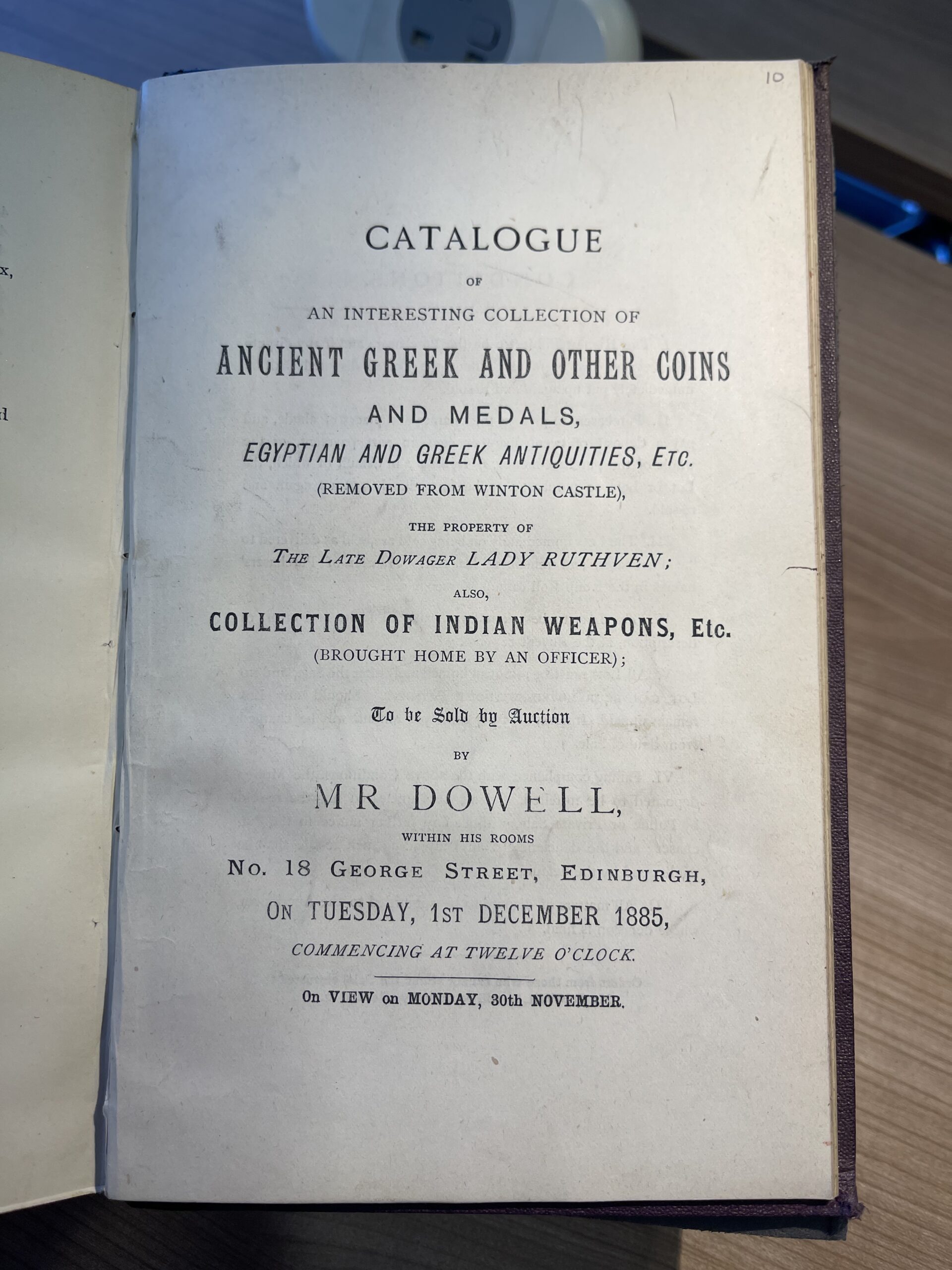
Dowell’s Catalogue of An Interesting Collection of Ancient Greek and Other Coins and Medals, Egyptian and Greek Antiquities, Etc. (removed from Winton Castle), the Property of The Late Dowager Lady Ruthven, 1 December 1885 © National Library of Scotland, ABS.4.84.5(10)
My study will tell the story of the only known woman active in archaeology in Greece during the early 19th century. This includes her contact with the local Ottoman community, such as Ali Pasha and Theresa Macri (Lord Byron’s ‘Maid of Athens’), and her financial support for the Philomousos Society on the eve of the Greek Revolution. The project builds on work I have done on travel and antiquities in Ottoman Greece (Petsalis-Diomidis 2025). My research will also highlight Lady Ruthven’s practice as an artist, analysing her watercolours of ancient remains held in the National Gallery of Scotland. In doing so, my work aims to significantly change our understanding of archaeological, graphic and cultural activities undertaken by Scots in the Grand Tour. Lady Ruthven’s story of Scottish engagement with Greece promises to be very different, yet complementary, to that of her cousin Mary Nisbett, Lady Elgin. It demonstrates diversity within ‘the Ruthven group’, building on my research on Robert Wilson, a physician of humble origin from Banff (Petsalis-Diomidis 2024).
The project also considers the afterlife of the antiquities in Scotland within Lady Ruthven’s broader art collection. This involves the identification of items bequeathed by her to the National Gallery of Scotland and the Society of Antiquaries of Scotland (now held in the National Museum of Scotland), and an analysis of the display of the collection in Winton Castle. It also puts forward an interpretation of Lady Ruthven’s own watercolours of classical remains as portals for imaginative journeys to Attica from East Lothian in the Victorian era.
By foregrounding this largely unknown first female excavator in Ottoman Greece and creator of a significant antiquities collection, I will tell a more inclusive story of Scottish travel and collecting on the Grand Tour.
Research trip to Edinburgh
Prior to my visit, I had acquired digital copies of the settlement and codicils of Lady Ruthven’s will from the National Records of Scotland. These were transcribed by a student research assistant, Kasia Middleton, at the University of St Andrews (funded by the Society). These documents provide detailed evidence of object bequests, and offer insights into the way Lady Ruthven valued objects for their material qualities (eg precious stones) or for their genealogy of ownership.
I made two visits to the National Library of Scotland, where I spent time deciphering Lady Ruthven’s letters to Mr Octavius Hill, a pioneer photographer. These demonstrate her interest in his calotypes in the 1860s and in showing them to her ‘English and foreign artistical friends’. I also examined Dowell’s annotated sales catalogue of antiquities from Lady Ruthen’s collection sold after her death in 1885.
At the National Museums Collection Centre, Dr Dan Potter and Dr Margaret Maitland gave me access to a sample of Lady Ruthven’s antiquities and art objects. The diversity of the collection was striking, including Scottish, Greek, Italian and Egyptian items. We spent time discussing the feasibility of making an in-depth reconstruction of Lady Ruthven’s collection with the available accession evidence. We laid the groundwork for a potential bid for a collaborative doctoral partnership.
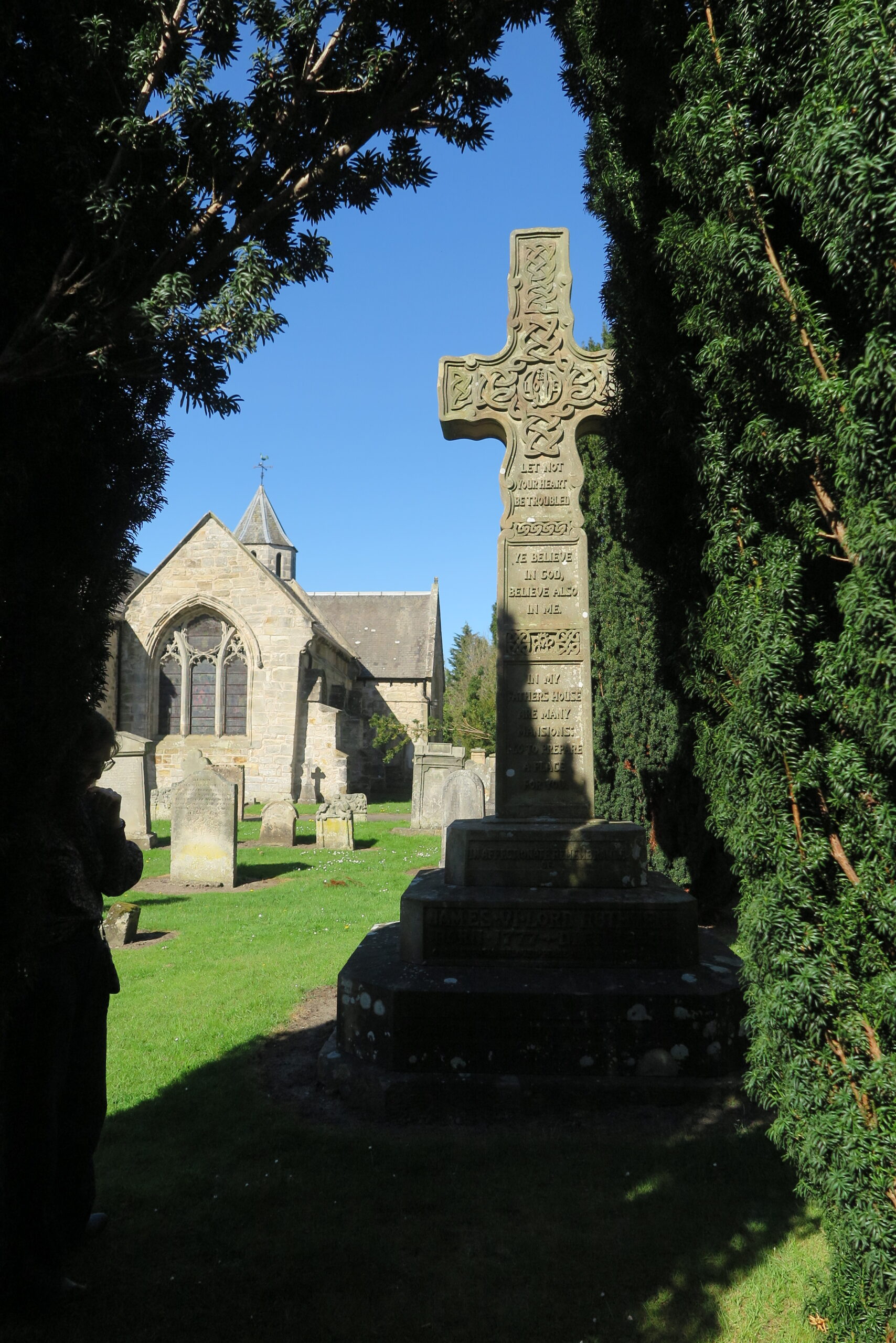
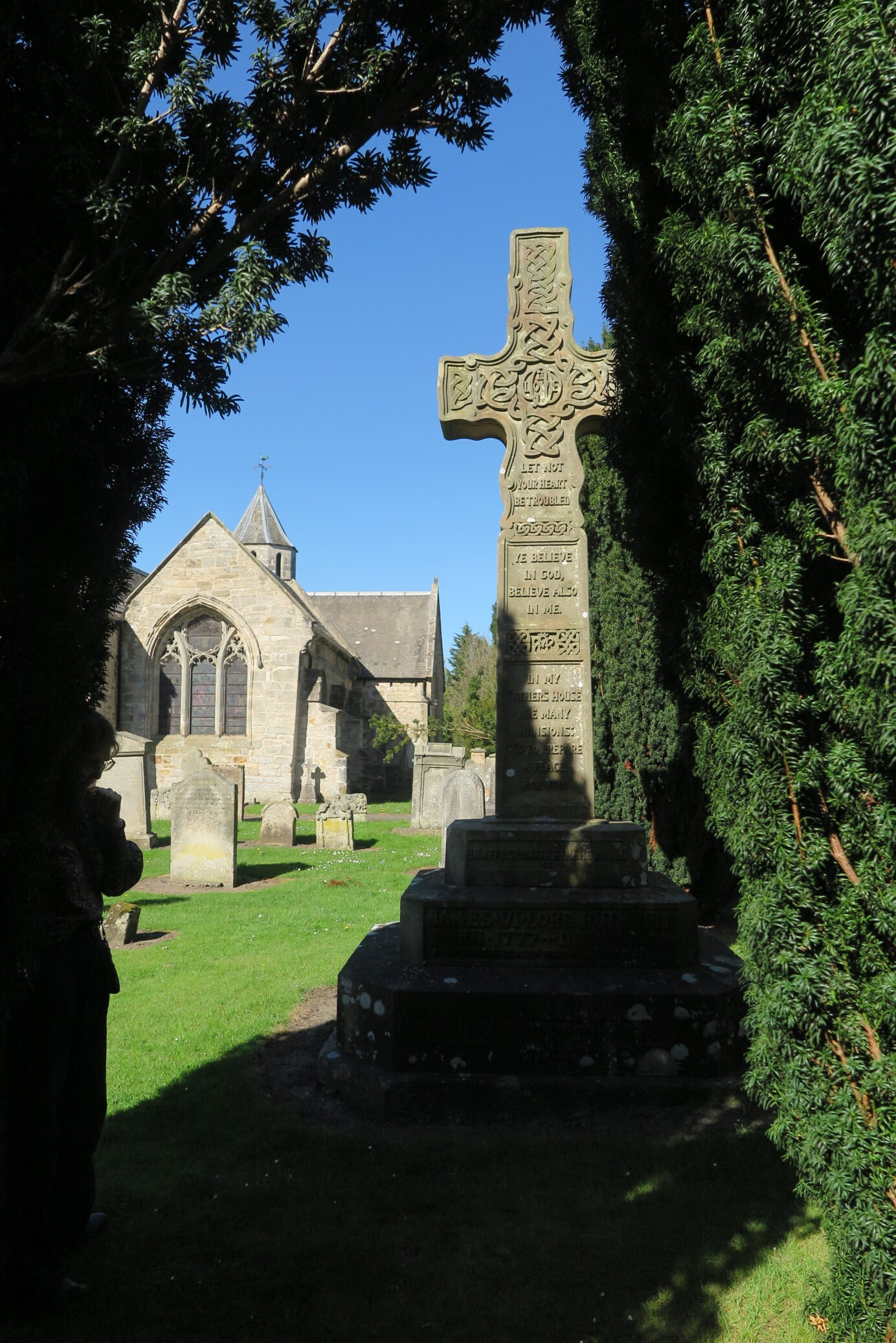
Monument erected by Lady Ruthven in memory of her husband James (1777-1853) in the churchyard of Pencaitland parish church © Alexia Petsalis-Diomidis
I visited the National Gallery of Scotland (Modern Two) and examined Lady Ruthven’s watercolours of ancient sites and antiquities and discussed them with Aidan Weston-Lewis, Chief Curator, European Art.
The most exciting day was my visit to Winton Castle, Lady Ruthven’s home in her later years, and where she kept her collection. Sir Francis and Lady Ogilvy, her indirect descendants, showed me the house and various items connected to Lady Ruthven, including family portraits, clothes and jewellery. They also told me the story of a beautiful carpet brought back from India by Lady Ruthven, which was still in the house until recent years. This adds a new dimension to her as a traveller and collector in British India. The family knew much about her philanthropic work around Winton, but had not heard about her antiquarian activities, highlighting the value in exchanging knowledge when unravelling lost histories.
In thinking about how this story could be given the prominence it deserves beyond academia, I had a discussion with Dr Sorcha Carey. Sorcha is the Director of Collective contemporary art centre on Calton Hill, and is experienced in commissioning contemporary artwork which can speak to a broad section of the community. We discussed different models of exhibitions, including collaborating with an artist curator who could evoke Lady Ruthven’s excavations, travels and experience of living with objects from different cultures in the East Lothians. Finally, I met with Stephanie Straine, Senior Curator of Modern and Contemporary Art at the National Galleries of Scotland in Edinburgh, and artist Lauren Gault. Lauren is currently working on a project which takes inspiration in part from Lady Ruthven’s Aristomache grave stele, which we examined together at the National Gallery storage facility.
Next steps
Since receiving a Society research grant, I have been awarded a Leverhulme Trust Research Fellowship for 2026-27 to work on my project ‘A New Approach to the Elgin Marbles: Archaeology, Intimacy and Collecting’. This includes an important element focusing on the Elgins as models for later Scottish antiquities collectors, including Lady Ruthven. My research on Lady Ruthven will thus be published in my new book and will be an important part of the broader story I intend to tell about the reception of antiquities generally and by Scottish women particularly.
Acknowledgements
I am very grateful to the Society as well as the individuals mentioned above who were generous with their time and expertise.
References
Petsalis-Diomidis, A (ed) 2025 Travel and Classical Antiquities in Nineteenth-Century Ottoman Greece: Exploring Marginalised Perspectives, British School at Athens – Modern Greek & Byzantine Studies Series, London: Routledge.
Petsalis-Diomidis, A 2024 ‘Robert Wilson (1787–1871) in Ottoman and revolutionary Greece: Through ‘the eye of an experienced traveller’’, in Beaton, R and Gaul, N (eds) The Greek Revolution of 1821: European Contexts, Scottish Connections, Edinburgh Leventis Series vol 12, Edinburgh: Edinburgh University Press, 209–249.
Report prepared by Alexia Petsalis-Diomidis